

There is no separate limit on money in the bank for the Age Pension. From 20 September 2026, a single homeowner with no other assets or income can have up to $192,320 in the bank and still get the full pension of $1,237.70 a fortnight. A homeowner couple can have up to $333,546 combined. Above those amounts the pension reduces, and with savings alone a single homeowner gets nothing once savings reach $745,750. Every figure on this page is worked out by the Age Pension calculator from the Services Australia rates in force from 20 September 2026.
Key takeaways
- Services Australia sets no separate bank limit. Savings are assessed with all your other assets.
- Savings count twice: at their balance in the assets test, and through deeming in the income test. The test that gives the lower rate is the one that applies.
- With savings only, deeming reduces the pension before the assets test does. The full pension stops above $192,320 for a single person and $333,546 for a couple.
- Report a rise of $2,000 or more in your financial assets within 14 days.
- Services Australia compares the bank details you give it with bank interest reported to the ATO.
Is there a limit on how much money a pensioner can have in the bank?
No. Services Australia assesses all asset types in the assets test, and bank, building society and credit union accounts are simply one of them, together with cash on hand. The money in your accounts is added to everything else you own and compared with the limits for your situation. The same savings are deemed to earn income, and that deemed income goes into the income test. Your pension is the lower of the two results.
So the answer to “how much can I have in the bank” depends on what else you own, what other income you have, whether you are single or a couple and whether you own your home. The sections below show the amounts for savings alone, then how other assets and income change them.
How bank savings count in the assets test
In the assets test, money in the bank counts at its balance. Deposits you can withdraw at call are counted at face value. Your savings are added to your other assets, such as a car, household contents, shares and investment property, and the total is compared with the full pension limit for your situation. Above the limit, the pension reduces by $3 a fortnight for every $1,000.
The limits themselves, the cut-off points and what is and is not counted are on Age Pension assets test limits and rules. To run the assets test on your own total, use the Age Pension assets test calculator.
How bank savings count in the income test (deeming)
Deeming assumes your financial assets earn a set rate of income, no matter what they really earn. Savings accounts and term deposits are financial assets. Services Australia adds the deemed income to your other income and applies the income test to the total.
For a single person, the first $66,800 of financial assets is deemed to earn 1.75% a year and everything above it 3.75%. For a couple where at least one partner gets a pension, the first $110,600 of combined financial assets is deemed at 1.75% and the rest at 3.75%. These deeming rates apply from 20 September 2026.
$66,800 at 1.75% is $1,169.00, and $33,200 at 3.75% is $1,245.00. Deemed income is $2,414.00 a year, or $92.85 a fortnight. That is what the income test counts, whatever interest the account actually pays.
If your account earns more than the deeming rates, the extra is not counted as income. To work out deemed income on your own balances, use the deeming calculator. The income test free areas and taper are on the Age Pension income test page.
How much you can have in the bank and still get the full pension
With savings and no other assets or income, the income test is the one that reduces the pension first. Deemed income reaches the income free area at a lower balance than the full pension limit in the assets test. One dollar more and the income test starts to take the pension down.
| Your situation | Most in savings for the full pension | Test that reduces it first |
|---|---|---|
| Single homeowner | $192,320 | Income test (deeming) |
| Single non-homeowner | $192,320 | Income test (deeming) |
| Couple homeowners, combined | $333,546 | Income test (deeming) |
| Couple non-homeowners, combined | $333,546 | Income test (deeming) |
Homeowners and non-homeowners have the same figure because deeming does not depend on your home. A single homeowner with $192,321 gets $1,237.70 a fortnight, set by the income test. These amounts assume no other assets: a car or household contents do not change the deeming figure, but they add to the assets test total.
When savings stop the part pension
As savings grow past the full pension amount, the income test reduces the pension first. Further up, the assets test gives the lower rate and takes over, and the pension falls by $3 a fortnight for every $1,000. With savings only, the part pension stops at the assets test cut-off point for your situation. The tables show the pension at different balances, with no other assets or income.
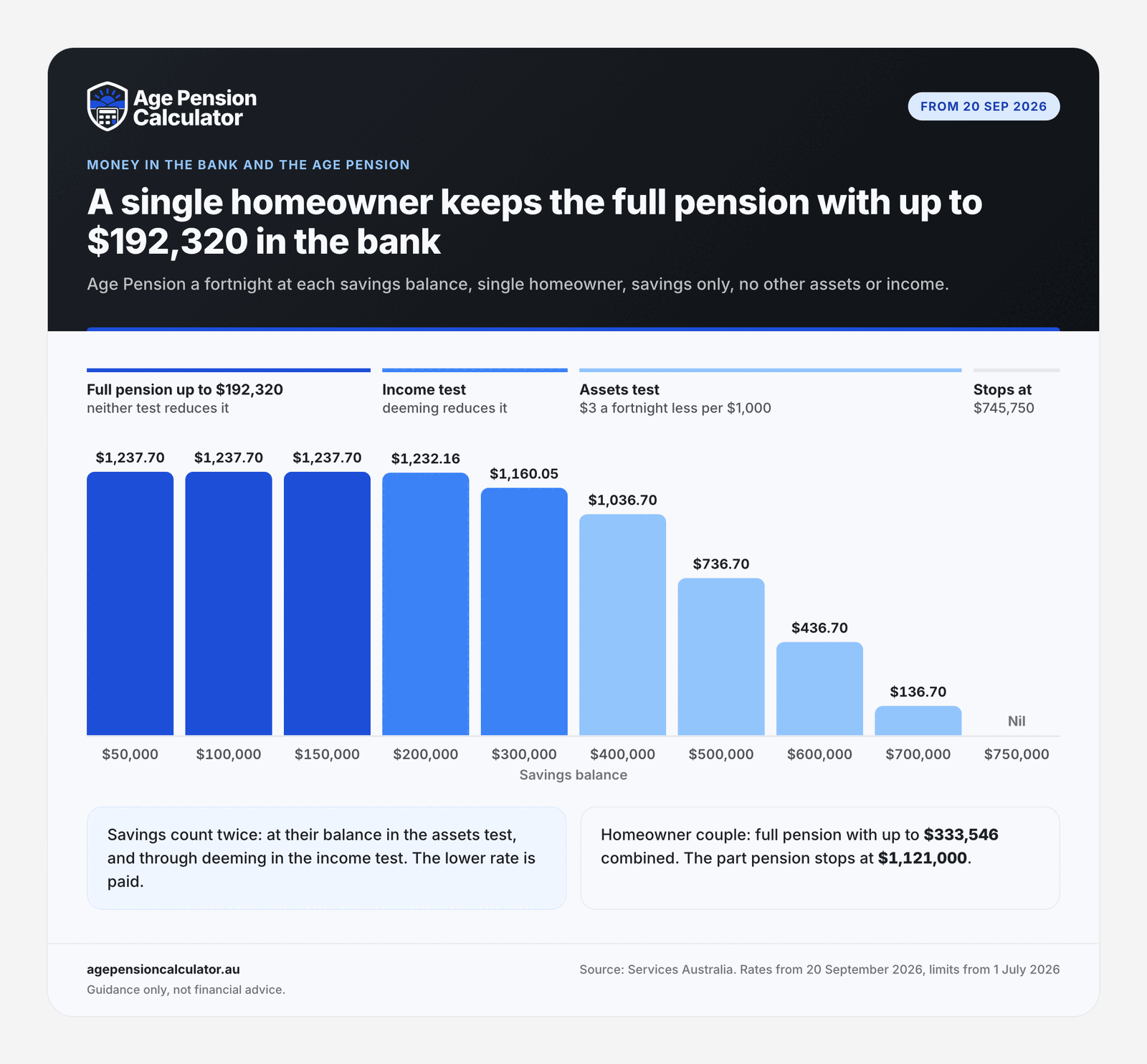
Figures in this graphic
| Savings | Pension a fortnight | Set by |
|---|---|---|
| $50,000 | $1,237.70 | Neither test |
| $100,000 | $1,237.70 | Neither test |
| $150,000 | $1,237.70 | Neither test |
| $200,000 | $1,232.16 | Income test |
| $300,000 | $1,160.05 | Income test |
| $400,000 | $1,036.70 | Assets test |
| $500,000 | $736.70 | Assets test |
| $600,000 | $436.70 | Assets test |
| $700,000 | $136.70 | Assets test |
| $750,000 | Nil | Part pension stops at $745,750 |
Single homeowner, savings only
| Savings | Deemed income a fortnight | Pension a fortnight | Set by |
|---|---|---|---|
| $50,000 | $33.65 | $1,237.70 | Neither test |
| $100,000 | $92.85 | $1,237.70 | Neither test |
| $150,000 | $164.96 | $1,237.70 | Neither test |
| $200,000 | $237.08 | $1,232.16 | Income test |
| $300,000 | $381.31 | $1,160.05 | Income test |
| $400,000 | $525.54 | $1,036.70 | Assets test |
| $500,000 | $669.77 | $736.70 | Assets test |
| $600,000 | $814.00 | $436.70 | Assets test |
| $700,000 | $958.23 | $136.70 | Assets test |
| $750,000 | $1,030.35 | Nil | Over the cut-off |
Homeowner couple, savings only
| Savings, combined | Deemed income a fortnight | Pension a fortnight, combined | Set by |
|---|---|---|---|
| $100,000 | $67.31 | $1,866.00 $933.00 each | Neither test |
| $200,000 | $203.38 | $1,866.00 $933.00 each | Neither test |
| $300,000 | $347.62 | $1,866.00 $933.00 each | Neither test |
| $400,000 | $491.85 | $1,818.08 $909.04 each | Income test |
| $500,000 | $636.08 | $1,745.96 $872.98 each | Income test |
| $700,000 | $924.54 | $1,263.00 $631.50 each | Assets test |
| $900,000 | $1,213.00 | $663.00 $331.50 each | Assets test |
| $1,100,000 | $1,501.46 | $92.80 $46.40 each minimum rate | Assets test |
Single non-homeowner, savings only
| Savings | Deemed income a fortnight | Pension a fortnight | Set by |
|---|---|---|---|
| $200,000 | $237.08 | $1,232.16 | Income test |
| $400,000 | $525.54 | $1,087.93 | Income test |
| $600,000 | $814.00 | $943.70 | Income test |
| $800,000 | $1,102.46 | $637.70 | Assets test |
| $1,000,000 | $1,390.92 | $61.60 minimum rate | Assets test |
Pensions are per fortnight at the rates from 20 September 2026. Where the reduction would leave less than the minimum rate but more than nil, the minimum rate is paid. For couples living together, see Age Pension for couples.
| Your situation | Savings at which the part pension stops |
|---|---|
| Single homeowner | $745,750 |
| Single non-homeowner | $1,012,750 |
| Couple homeowners, combined | $1,121,000 |
| Couple non-homeowners, combined | $1,388,000 |
Savings plus other assets: which test decides your rate
Other assets do not change deemed income, but they add to the assets test total. Other income adds to deemed income in the income test. Two examples for a single homeowner:
- $100,000 in the bank plus a car and contents worth $40,000. Assets total $140,000 and deemed income stays at $92.85 a fortnight. The pension is $1,237.70 a fortnight, the full rate. Neither test reduces it.
- $150,000 in the bank plus $400 a fortnight of other income, such as a small private pension. Assessable income is $564.96 a fortnight, so the pension is $1,068.22, set by the income test. With the same savings and no other income it would be $1,237.70.
To see both tests on your own figures, with the working, use the Age Pension calculator.
Does Centrelink check your bank account?
Yes, in these ways, as Services Australia describes them:
- It compares the bank information you give it with how much bank interest the Australian Taxation Office says you got in past financial years.
- It data matches with the ATO on non-employment income, including income from investments.
- It uses the balance you tell it to assess your deemed income, so the figure you report matters.
- If it sends you a letter about a bank interest review, you need to call within 28 days of getting the letter.
Services Australia also says it does not already know everything about you. If something changes, you need to tell it so you are paid the right amount.
When to tell Centrelink your bank balance has changed
You must tell Services Australia about changes to your income or assets within 14 days. For savings and other financial assets, that means when their value goes up by $2,000 or more. For other assets the amount is $1,000 or more.
Gifts out of your account have their own rules: amounts over the gifting free areas still count as your assets for 5 years. See Age Pension gifting rules.
Cash at home, couples and money from super
- Cash at home. Cash on hand is a financial asset. Services Australia accepts your estimate of its value, apart from cash you hold to meet day-to-day expenses.
- Couples. The limits are for both partners' assets combined, and one deeming threshold of $110,600 applies to the couple's combined financial assets.
- Money from super. Taking money out of super does not itself affect the pension, but what you do with it may. Money moved into the bank is counted in both tests like any other savings. See Age Pension and super.
Questions about money in the bank
How much money can a pensioner have in the bank?
Does Centrelink check bank accounts?
Do I have to tell Centrelink when my bank balance goes up?
Does the interest my bank actually pays count?
Does cash kept at home count?
Is the limit different for couples?
- Services Australia: Assets test for Age Pension, Asset types, Deeming, Income test for Age Pension, Bank interest income reviews, Centrelink data matching activities, When to report your income, Superannuation
- DSS Social Security Guide: 4.2.3 Pensions and benefits assets tests, 4.6.5.10 Assessing personal effects, household contents, vehicles and cash
Rates from 20 September 2026.
Read 24 November 2026.
The Age Pension calculator runs both tests on your savings, other assets and income and shows which one sets your rate.