
If you are 21 or older, the Disability Support Pension (DSP) assets test uses the same limits as the Age Pension. A single homeowner keeps the full DSP with assets up to $333,000, and part DSP stops at $745,750. The full pension limits apply from 1 July 2026 and the cut-off points from 20 September 2026. If you are under 21 and have no children, the cut-off points are lower. If you are permanently blind, the assets test may not apply to you at all.
Key takeaways
- Services Australia publishes the same assets test limits and cut-off points for DSP and the Age Pension.
- For a couple, the limits are for both partners' assets combined.
- Every $1,000 over the limit takes $3 a fortnight off DSP for a single person, or $1.50 a fortnight off each partner's DSP for a couple.
- Your home and up to 2 hectares of land are generally not counted. Super counts once you are over Age Pension age or are paid from it.
- Under 21 with no children, DSP stops at lower cut-off points.
- If you are permanently blind, you may not be income or assets tested unless you claim Rent Assistance or your partner claims an income support payment.
Disability pension assets test limits for the full DSP
Services Australia assesses all asset types in the DSP assets test. How much you can own and still get the full DSP depends on whether you are single or part of a couple, and whether you own your home. For a couple, the limit is for both partners' assets combined.
| Your situation | Homeowner | Non-homeowner |
|---|---|---|
| Single | $333,000 | $600,000 |
| Couple, combined | $499,000 | $766,000 |
| Couple separated by illness, combined | $499,000 | $766,000 |
| Couple, one partner eligible, combined | $499,000 | $766,000 |
With assets at or below the limit, the assets test does not reduce your DSP. Above it, DSP reduces until it stops at the cut-off point. The Department of Social Services reviews these limits and cut-off points in January, March, July and September each year.
When part DSP stops: the cut-off points
DSP stops when your assets are over the cut-off point for your situation. These cut-off points apply from 20 September 2026. Under-21s without children have their own, further down this page.
| Your situation | Homeowner | Non-homeowner |
|---|---|---|
| Single | $745,750 | $1,012,750 |
| Couple, combined | $1,121,000 | $1,388,000 |
| Couple separated by illness, combined | $1,324,500 | $1,591,500 |
| Couple, one partner eligible, combined | $1,121,000 | $1,388,000 |
If you get Rent Assistance with your DSP, your cut-off point is higher. Transitional rate pensioners have separate cut-off points, listed on the Services Australia assets test for Disability Support Pension page.
How assets reduce DSP
Above the full pension limit, every $1,000 of assets reduces DSP by $3 a fortnight if you are single, or by $1.50 a fortnight for each member of a couple. The DSS Social Security Guide counts the amount over the limit in whole steps of $250 and ignores any part step, so each step is worth $0.75 a fortnight.
That is $117,000 over the $333,000 limit, or 468 steps of $250. DSP reduces by $351.00 a fortnight, so the assets test leaves $886.70 of the $1,237.70 maximum.
Is the DSP assets test the same as the Age Pension assets test?
Yes, if you are 21 or older. The Services Australia assets test pages for DSP and the Age Pension show the same full pension limits and the same cut-off points. The DSS Social Security Guide keeps one table of assets limits for the age and disability support pension, and says the pensions assets test applies to all pensions.
The maximum DSP at 21 and over is also the same as the Age Pension: $1,237.70 a fortnight for a single person and $933.00 each for a couple, from 20 September 2026. So the Age Pension assets test calculator applies the DSP limits and reduction to the assets you enter. Its results are labelled for the Age Pension, and it does not cover under-21 rates or the permanent blindness exemption.
The full list of what is and is not counted, and how a couple's assets are shared, is in Age Pension assets test limits and rules.
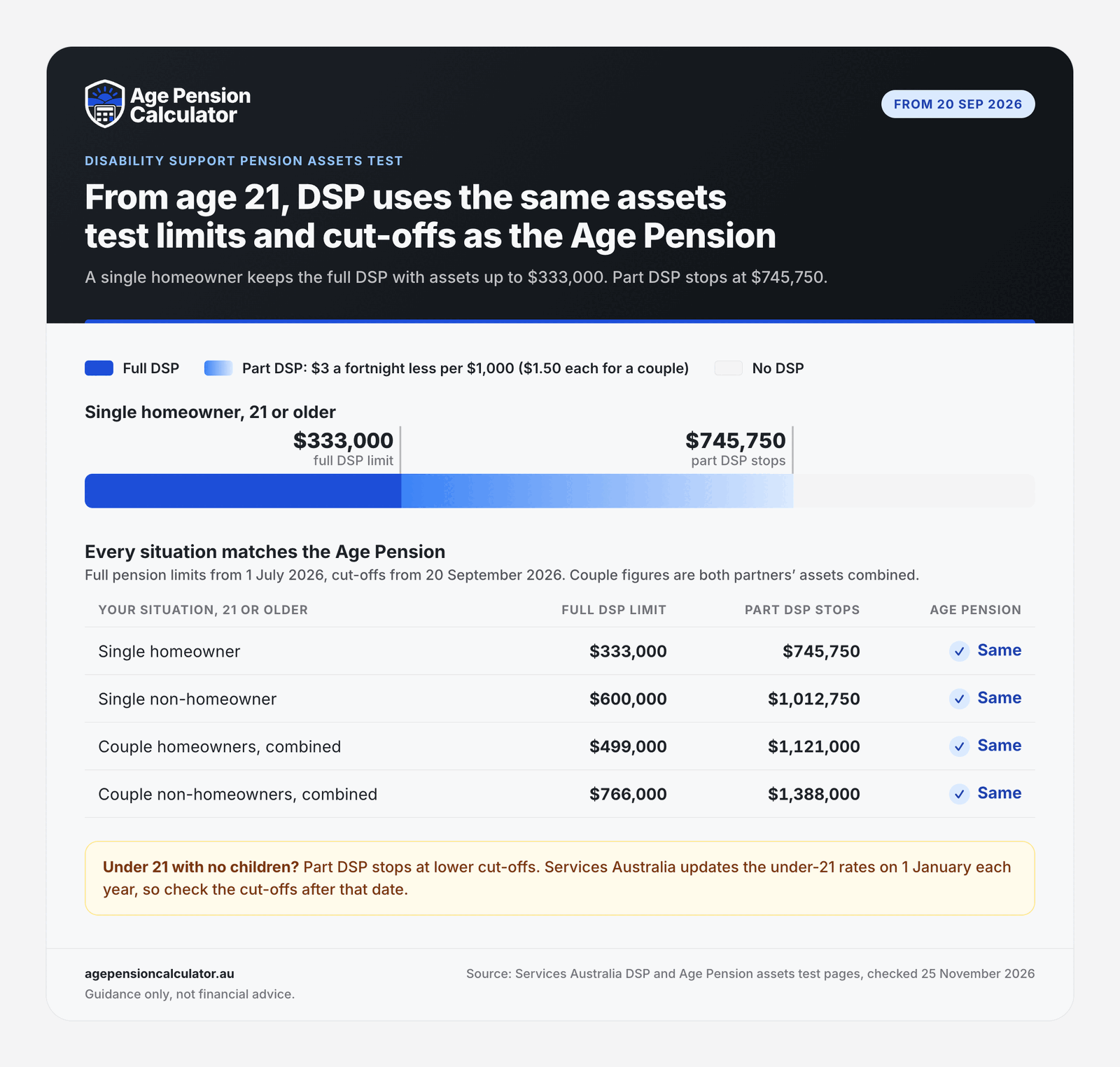
Figures in this graphic
| Your situation, 21 or older | Full DSP limit | Part DSP stops | Age Pension |
|---|---|---|---|
| Single homeowner | $333,000 | $745,750 | Same |
| Single non-homeowner | $600,000 | $1,012,750 | Same |
| Couple homeowners, combined | $499,000 | $1,121,000 | Same |
| Couple non-homeowners, combined | $766,000 | $1,388,000 | Same |
DSP assets test if you are under 21 with no children
If you are under 21 and have no dependent children in your care, DSP is paid at different rates. How much you get depends on whether Services Australia assesses you as dependent or independent. DSP stops at these cut-off points, which apply from 20 September 2026:
| Your situation | Homeowner | Non-homeowner |
|---|---|---|
| 16 or 17, single, dependent | $531,250 | $798,250 |
| 18 to 20, single, dependent | $552,750 | $819,750 |
| 16 to 20, single, independent | $618,500 | $885,500 |
| 16 to 20, couple, combined | $1,067,500 | $1,334,500 |
For a couple, the cut-off is for both partners' assets combined. If you get Rent Assistance, your cut-off point is higher. Services Australia updates the rates for under-21s without children on 1 January each year, so check these figures after that date. Your parents' or guardians' income does not affect how much DSP you get.
If you are under 21 and have a child in your care, you are paid the same rates as people aged 21 and over.
Permanently blind: no income or assets test
If you are permanently blind, you may not be subject to the income or assets test. Services Australia lists two exceptions: you claim Rent Assistance, or your partner claims an income support payment.
- Permanently blind means corrected vision of less than 6/60 in both eyes on the Snellen scale, a visual field of 10 degrees or less in the better eye, or a combination of defects with the same effect. A report from your treating ophthalmologist confirming this is accepted.
- If you want Rent Assistance, you can choose to be income and assets tested. Services Australia then compares the tested rate plus Rent Assistance with the rate free of the means tests, and pays the higher amount.
- If your partner gets a pension and is not also permanently blind, their pension is income and assets tested.
- Compensation for damages can still change your DSP.
Couples: when your partner gets the Age Pension or another payment
If you are a member of a couple, the DSP limits are for your and your partner's assets combined. Above the limit, each partner's DSP reduces by $1.50 a fortnight for every $1,000.
- Partner on the Age Pension. The Age Pension uses the same pensions assets test, with the same combined couple limits and cut-off points. Your combined assets are compared with the same figures for both payments.
- Partner on JobSeeker Payment or another allowance. Their payment is under the benefits assets test, which is different. JobSeeker Payment, Youth Allowance, Austudy, Special Benefit and Parenting Payment are not payable at all if assets exceed the assets free area.
- Only one of you eligible. Services Australia lists the same combined limits and cut-off points for a couple where one partner is eligible.
- Separated by illness. The full pension limits are the same and the cut-off points are higher: $1,324,500 combined for homeowners and $1,591,500 for non-homeowners.
What counts as an asset for DSP, and is your home exempt?
Your assets are any property or possessions you or your partner own in full, in part or have an interest in, including assets outside Australia and debts owed to you. Each is valued at what you would get if you sold it at market value, less any debt secured on it. Assets include:
- bank, building society and credit union accounts, and cash on hand
- shares, managed investments and other financial investments
- cryptocurrency
- real estate other than your home, including property you rent out, leave vacant or let someone live in for free
- home contents, personal effects, motor vehicles, boats and caravans
- super, if you are over Age Pension age or you receive payment from it
Your home. The real estate counted in the assets test generally does not include your principal home and up to the first 2 hectares of land it is on. Owning your home puts you on the lower homeowner limits.
Tell Services Australia when the value of your assets goes up by $2,000 or more for financial assets, or $1,000 or more for other assets.
Hardship, special disability trusts, compensation and inheritances
- Asset hardship. If you are in severe financial hardship and your assets mean you get no DSP or only a small amount, you can apply under the asset hardship provisions.
- Special disability trusts. If you are the principal beneficiary of a special disability trust, the trust's assets up to $862,750 (from 1 July 2026) are exempt from your assets test. Assets above that amount count as yours. A home held in the trust is exempt. Tell Services Australia if you are a beneficiary of a special disability trust or have donated to one.
- Compensation. Compensation for damages paid to you or your partner can change how much DSP you get.
- Inheritances. Tell Services Australia within 14 days of getting assets or income from a deceased estate. Estate assets are generally assessed once you get them, are able to get them or benefit from them.
- Gifts. Giving away money, assets or income can affect your DSP, depending on the amount.
The income test also applies
How much DSP you get depends on your assessable income as well as your assets. Services Australia uses thepension income test for DSP, and deeming to work out the income your financial assets are taken to earn. The assets test only applies if it gives a lower rate than the income test. If you are over Age Pension age and working, the Work Bonus can help you keep more of your pension.
For DSP payment rates and how to claim, see Disability Support Pension on the Services Australia website.
Questions about the DSP assets test
Is the DSP assets test the same as the Age Pension assets test?
How much in assets can you have on the Disability Support Pension?
Can you get DSP if you have savings?
Will I lose DSP if I inherit money?
Is the DSP assets test different if you are under 21?
Are permanently blind DSP recipients assets tested?
- Services Australia: Assets test for Disability Support Pension (page updated 20 September 2026), Income and assets tests for Disability Support Pension, Payment rates for Disability Support Pension, Income test for Disability Support Pension, Asset types, Assets test for Age Pension
- DSS Social Security Guide: 4.2.3 Pensions and benefits assets tests, 4.10.3 Historical age and invalid (disability support) pension income and assets limits, 4.3.1.30 Rate of income: couples, blind pensioners and children, 3.6.2.40 Assessment of permanent blindness for DSP, 3.6.1.50 Payability of DSP, 1.1.P.210 Permanent blindness, 4.14.3.40 Means testing of special disability trusts
Full pension limits from 1 July 2026. Cut-off points from 20 September 2026.
Read 25 November 2026.
If you are 21 or older, the Age Pension assets test calculator applies the same limits and reduction to your assets and shows the working.