
Super does not count for the Age Pension while you are under Age Pension age (67) and your fund is not paying you a pension. From 67, your super counts in the assets test at the balance on your latest statement and is deemed to earn income in the income test. The same rule applies to your partner's super once they reach 67, even if they get no payment. A super pension that is already paying is counted at any age.
Key takeaways
- Under 67, super left in accumulation is not counted for you or your partner.
- From 67, super counts in both tests, like savings: at its balance and through deeming.
- An account-based pension counts at its balance. The payments you draw are not counted as income on top.
- Account-based pensions must pay a minimum each year, from 4% of the balance and rising with age.
- Lump sums taken out of super are not income, but what you do with the money can count.
Does super count for the Age Pension?
It depends on your age and whether your fund is paying you a pension. Super sitting in accumulation is left out until its owner reaches Age Pension age. From that age it is assessed in both means tests. A super pension, such as an account-based pension, is assessed from the day it starts paying, at any age.
| Your super | Under 67 | 67 or older |
|---|---|---|
| In accumulation, not paying a pension | Not counted | Counted in both tests, deemed |
| Paying an account-based pension | Counted as an income stream | Counted in both tests, deemed |
Before Age Pension age: when super is not counted
Services Australia does not count your super, or your partner's, in the income and assets tests if your fund is not paying you a super pension. The DSS Social Security Guide shows the same thing: super in accumulation is disregarded under Age Pension age. If your fund is paying you a super pension, it is assessed as an income stream even before you reach 67.
From Age Pension age: super in the assets test and the income test
From 67, all your super is assessed. In the assets test, its value is the balance on your latest statement, added to your other assets. In the income test, it is a financial asset under the deeming rates: for a single person 1.75% on the first $66,800 of all financial assets and 3.75% above it, from 20 September 2026. The limits it is tested against are on Age Pension assets test limits and rules.
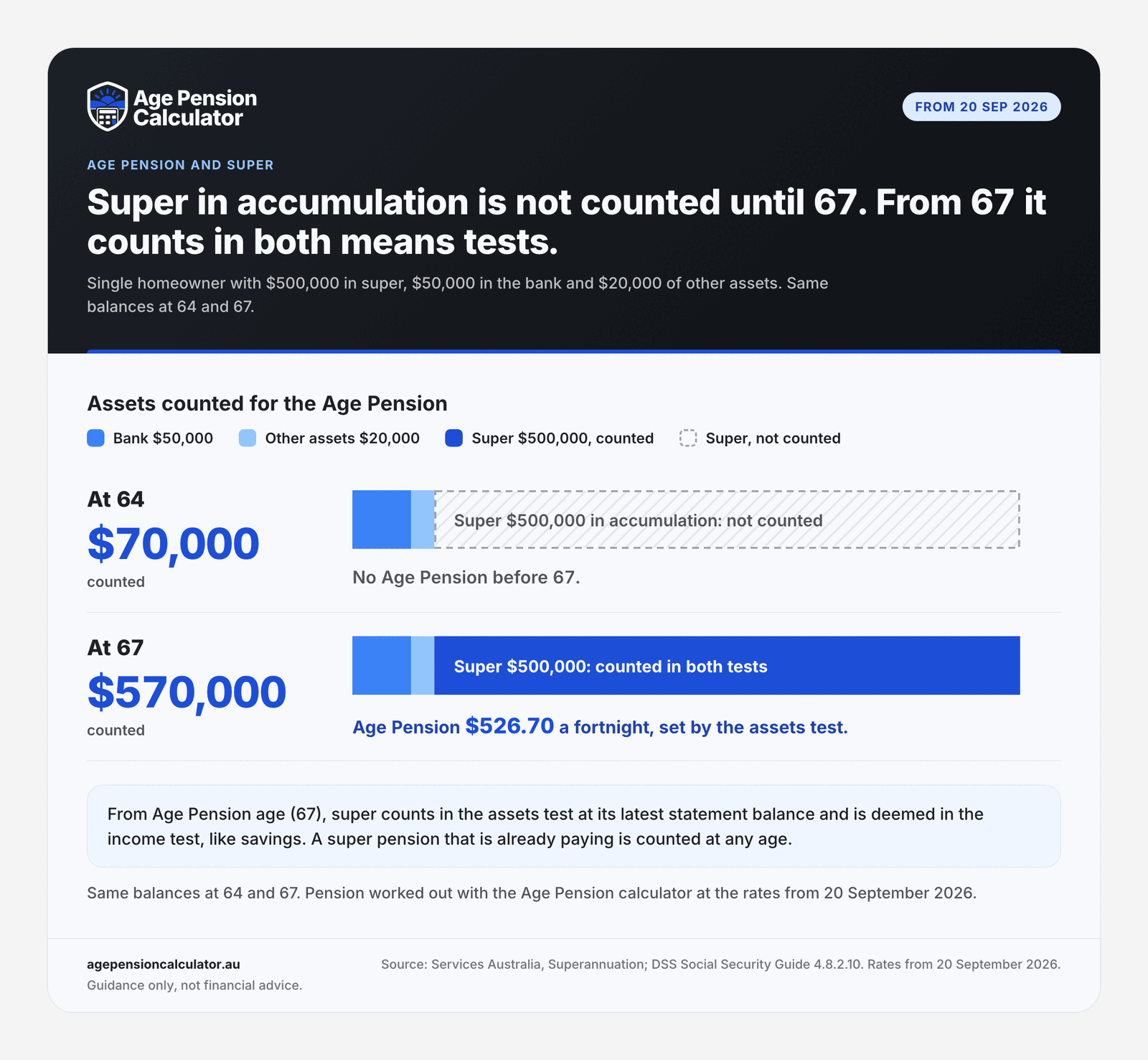
At 64, only $70,000 counts, because the super is in accumulation, but there is no Age Pension before 67 anyway. At 67, the super joins the assets test and deeming. Assets counted rise to $570,000, and the pension is $526.70 a fortnight, set by the assets test. Figures from the Age Pension calculator at current rates, with the same balance at 67.
Figures in this graphic
| Age | Super counted | Assets counted | Age Pension a fortnight |
|---|---|---|---|
| At 64 | No: $500,000 in accumulation | $70,000 | None before 67 |
| At 67 | Yes: $500,000, in both tests | $570,000 | $526.70, set by the assets test |
Your partner's super
Your partner's super follows the same rule. It is not counted while they are under Age Pension age and it is not paying them a pension. Once they reach 67, it is counted in both tests, even if they are not getting a payment. For a couple, the limits and the deeming threshold ($110,600) apply to both partners' assets combined.
Now: your partner's super is not counted, so financial assets are $340,000. Only you are paid, $930.67 a fortnight. When your partner reaches 67 (same balances), their super counts too, financial assets are $590,000, and you are both paid, $796.50 each or $1,593.00 combined.
When you can access your super: preservation age and conditions of release
Your preservation age is 60 if you were born after 30 June 1964, which covers anyone reaching it now. You can generally access your super:
- at or after preservation age, once you retire from the workforce
- from 65, even if you are still working
From 60, ending any job counts as retiring for super purposes. Reaching preservation age without retiring only lets you start a non-commutable income stream, such as a transition to retirement pension. You can retire at any age, but the Age Pension does not start until 67. To work out the dates for your own birthday, use the pension age calculator.
Super in accumulation vs an account-based pension
The accumulation phase is the working years when money is paid into super. The draw down phase is when you turn some or all of it into regular payments from an income stream. The most common is an account-based pension: a flexible income stream bought with super that must pay at least a minimum amount each year. Its payments are tax free from 60.
For the Age Pension, an account-based pension bought on or after 1 January 2015:
- counts in the assets test at its account balance
- is deemed in the income test, using the balance on your latest statement
- has its payments left out of the income test, because the balance is already deemed
Account-based pensions held continuously by the same person since 31 December 2014 keep the older rules, and are not covered on this page. Lifetime income streams bought from 1 July 2019 are assessed differently: 60% of the gross payments count as income.
Minimum drawdown rates for account-based pensions
The minimum payment for a year is the account balance on 1 July (or on the day the pension starts) times the percentage for your age, rounded to the nearest $10. These are the rates in Schedule 7 of the Superannuation Industry (Supervision) Regulations 1994, shown on a $400,000 balance:
| Age on 1 July | Minimum each year | On $400,000 |
|---|---|---|
| Under 65 | 4% | $16,000 |
| 65 to 74 | 5% | $20,000 |
| 75 to 79 | 6% | $24,000 |
| 80 to 84 | 7% | $28,000 |
| 85 to 89 | 9% | $36,000 |
| 90 to 94 | 11% | $44,000 |
| 95 or more | 14% | $56,000 |
So at 67, a $400,000 account-based pension must pay at least $20,000 that year. A pension that starts on or after 1 June needs no payment for that financial year, and one that starts on another date has its first minimum pro-rated.
Taking a lump sum out of super
Taking money out of super does not itself affect your Age Pension, and lump sum withdrawals are not counted as income. What you do with the money may count. Put in the bank, it is a financial asset in both tests. Given away, the Age Pension gifting rules apply. If you cannot access your super at Age Pension age, you may be able to have it exempted from both tests.
Transition to retirement pensions
A transition to retirement pension lets you draw on super from preservation age while you keep working. Until you meet a full condition of release, such as retiring or turning 65, it can pay no more than 10% of the account balance in a financial year. Because it is a super pension that is paying, it is assessed as an income stream for the Age Pension, even before Age Pension age.
Downsizer contributions and the Age Pension
From age 55, you can put up to $300,000 of the proceeds of selling your home into super as a downsizer contribution, less any earlier downsizer contributions. You or your spouse must have owned the home for the 10 years before the sale, and the contribution must be made within 90 days of the change of ownership. A downsizer contribution that is not meant for a new home is recorded as super, so from Age Pension age it counts in both tests like the rest of your super.
Can you retire at 60 with your super and get the Age Pension later?
Yes. You can retire and draw on super from 60, but the Age Pension does not start until 67. In between, super in accumulation is not counted. At 67, whatever balance is left, plus your savings and other assets, goes into both tests. The more you draw before 67, the lower the balance counted at 67 and the higher the pension can be, but the less super you have left.
To see this year by year for your own balance, drawdown and return, use the Age Pension and Super Calculator. For savings outside super, see how much money a pensioner can have in the bank, and for the income test itself the Age Pension income test.
Questions about super and the Age Pension
Does my super count for the Age Pension?
Does my partner's super count?
What is the difference between super and the Age Pension?
When can I access my super?
How is an account-based pension treated?
What are the minimum drawdown rates?
Can I retire at 60 with $600,000 in super?
Does a downsizer contribution affect the Age Pension?
- Services Australia: Superannuation, Income streams (page updated 18 November 2026), Deeming
- Operational Blueprint: 108.05070000 Superannuation
- DSS Social Security Guide: 4.8.2.10 Superannuation, 3.9.3.31 Account-based income streams
- Legislation: Superannuation Industry (Supervision) Regulations 1994 Schedules 1 and 7, reg 6.01
- Income Tax Assessment Act 1997 s292-102
Read 24 November 2026.
The Age Pension and Super Calculator shows your super balance, drawdown and Age Pension for each year. For one year at today's figures, use the Age Pension calculator.