

From 20 September 2026, Centrelink's deeming rates are 1.75% and 3.75% a year. 1.75% applies to financial assets up to $66,800 for a single person, or $110,600 combined for a couple where at least one gets a pension, and 3.75% applies to the amount above. For a couple where neither gets a pension, the threshold is $55,300 each. The thresholds apply from 1 July 2026.
Key takeaways
- Deeming assumes your savings, shares and other financial assets earn a set rate of income, whatever they really earn.
- The rates rose in three steps of 0.5 percentage points after the freeze ended, to 1.75% and 3.75% from 20 September 2026.
- The Australian Government Actuary reviews the rates every 6 months and the Minister sets them.
- No change had been announced for the next review when this page was checked on 24 November 2026.
- Super is deemed once its owner reaches Age Pension age.
Deeming rates from 20 September 2026
| Your situation | 1.75% a year on | 3.75% a year on |
|---|---|---|
| Single | the first $66,800 | everything over $66,800 |
| Couple, at least one on a pension | the first $110,600, combined | everything over $110,600 |
| Couple, neither on a pension | the first $55,300 each | everything over $55,300 each |
Rates from 20 September 2026; thresholds from 1 July 2026. A couple where only one partner gets a pension uses the combined $110,600 threshold. In a couple where neither gets a pension, each partner's own assets plus their share of joint assets are deemed separately.
The deeming calculator applies these rates to your financial assets and shows the amount in each tier, a year and a fortnight.
What deeming is and why Centrelink uses it
Deeming assumes your financial assets earn a set rate of income, no matter what they really earn. That deemed amount is added to your other income in the Age Pension income test. If your investments earn more than the deeming rates, the extra is not counted as income. Under the Social Security Act, the return you actually earn on a deemed financial asset is not ordinary income at all.
Services Australia says deeming keeps payments steady instead of going up and down with the performance of your investments. Deeming does not affect Family Tax Benefit. Deemed income only changes your payment when the income test is the test setting your rate: if you get the full rate, or the assets test gives the lower rate, it is not reducing your fortnightly payment. The same savings also count at their value in the Age Pension assets test.
The Australian Government Actuary worked out that a single pensioner with $100,000 of financial assets would need an overall return of 2.41% to match the rates from 20 September 2026. At those rates, $100,000 is deemed to earn $2,414.00 a year.
Deeming rate history: the freeze and the three steps to 1.75% and 3.75%
The rates were cut to 0.25% and 2.25% on 1 May 2020 and held there until September 2025. The Australian Government Actuary records that the deeming rate freeze ended on 30 June 2025, and the government is resetting the rates gradually. Since then they have risen in three steps:
- 20 September 2025: 0.75% and 2.75%
- 20 March 2026: 1.25% and 3.25%
- 20 September 2026: 1.75% and 3.75%
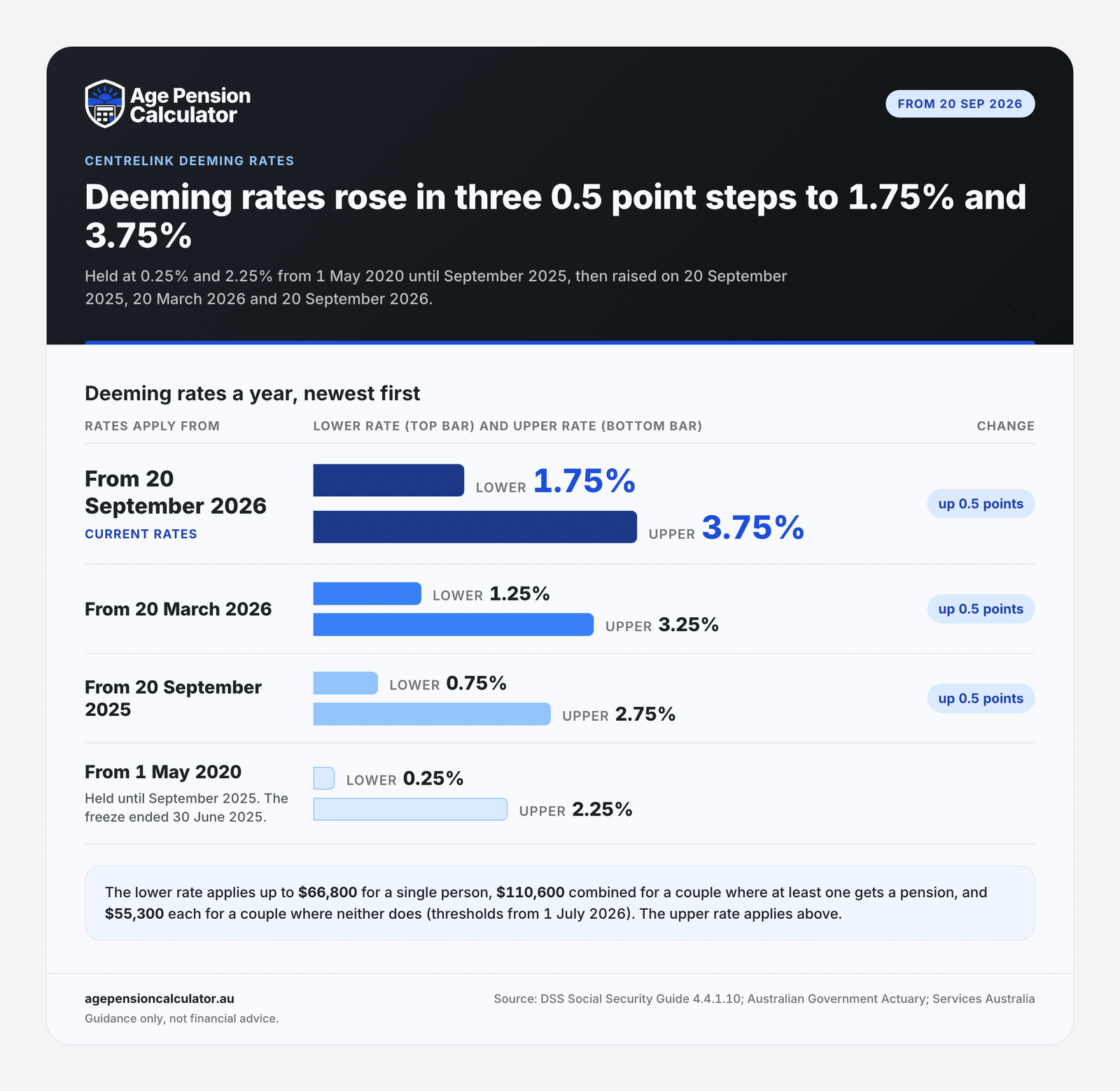
Figures in this graphic
| Rates apply from | Lower rate | Upper rate | Change |
|---|---|---|---|
| 20 September 2026 | 1.75% | 3.75% | Up 0.5 points |
| 20 March 2026 | 1.25% | 3.25% | Up 0.5 points |
| 20 September 2025 | 0.75% | 2.75% | Up 0.5 points |
| 1 May 2020 | 0.25% | 2.25% | Held until September 2025. The freeze ended 30 June 2025. |
For the 20 September 2026 step, the Actuary capped the increase to each rate at 0.5 percentage points, keeping the pace of the two earlier increases. The table below is taken from the DSS Social Security Guide. The thresholds are also indexed on 1 July in the years not shown.
| From | Lower rate | Upper rate | Single | Pensioner couple | Non-pensioner couple, each |
|---|---|---|---|---|---|
| 20 September 2026 | 1.75% | 3.75% | $66,800 | $110,600 | $55,300 |
| 1 July 2026 | 1.25% | 3.25% | $66,800 | $110,600 | $55,300 |
| 20 March 2026 | 1.25% | 3.25% | $64,200 | $106,200 | $53,100 |
| 20 September 2025 | 0.75% | 2.75% | $64,200 | $106,200 | $53,100 |
| 1 July 2025 | 0.25% | 2.25% | $64,200 | $106,200 | $53,100 |
| 1 July 2024 | 0.25% | 2.25% | $62,600 | $103,800 | $51,900 |
| 1 May 2020 | 0.25% | 2.25% | $51,800 | $86,200 | $43,100 |
| 1 July 2019 Applied retrospectively | 1.00% | 3.00% | $51,800 | $86,200 | $43,100 |
Deeming of bank accounts began in 1991. On 1 July 1996 it was extended to term deposits, managed investments, loans and debentures and listed shares, with rates of 5% and 7%. Since 1 January 2015 account-based income streams have been deemed as well.
Who sets the deeming rates
The Minister for Social Services sets the rates by legislative instrument under the Social Security Act 1991. The government has asked the Australian Government Actuary to review the rates every 6 months and recommend settings to the Minister. The Actuary's first review set the rates from 20 March 2026 and its second set the rates from 20 September 2026. The Minister's release of 20 August 2026 said the government had accepted the Actuary's recommendation.
The lower rate is meant to reflect the returns on safe, accessible products such as bank accounts. The upper rate reflects the higher returns on investments that are less accessible or carry more risk.
When the deeming rates change next
No new deeming rate had been announced or recommended when this page was checked on 24 November 2026. Services Australia's staff procedures label the current rates as applying from 20 September 2026 to 19 March 2027. That end date marks the next review point. It is not an announced change. The Actuary says it will keep monitoring returns at least every six months. The thresholds are indexed on 1 July each year.
What counts as a financial asset
The main types of financial assets that are deemed are:
- savings accounts, cheque accounts, term deposits and cash management accounts
- cash, and money held in solicitors' trust accounts
- managed investments, listed shares and securities, and shares in unlisted public companies
- bonds, debentures, unsecured notes and bank bills
- loans you have made to individuals, private companies and trusts
- gold and other bullion
- some income streams, including account-based pensions
- gifts over the gifting free areas, which are deemed for 5 years from the date of the gift
- advance payments under the Home Equity Access Scheme
Home loan offset accounts are deemed. A line of credit account is not. You do not need to tell Centrelink about reasonable amounts of cash kept for day-to-day living. For the gifting free areas, read Age Pension gifting rules. For how savings affect the pension overall, read how much money a pensioner can have in the bank.
Super and account-based pensions
Super in accumulation is not counted while its owner is under Age Pension age, unless the fund is paying a pension. From Age Pension age it is deemed, and the same applies to your partner's super once your partner reaches that age, even if they get no payment.
Account-based pensions are deemed if you bought them on or after 1 January 2015, or if you were off payment for any reason after 31 December 2014. The whole balance is deemed, whatever amount you draw. Those held immediately before 1 January 2015 may be grandfathered under the old rules until the holder changes products or stops getting an income support payment. Defined benefit income streams are not deemed. For the Commonwealth Seniors Health Card income test, deeming applies only to account-based income streams. For more, read Age Pension and super.
Financial assets are deemed on their gross value
Deeming uses the market value of an investment, before any loan against it. Shares worth $25,000 with a $10,000 loan against them are deemed on $25,000, while the assets test counts $15,000. Deeming applies to the value after any entry fee: $10,500 invested with a $300 entry fee is deemed on $10,200.
Selling your home: proceeds deemed at the lower rate
For home sales from 1 January 2023, the sale proceeds you intend to use for a new principal home are deemed at the lower rate, currently 1.75%, on the whole amount. This lasts for up to 2 years from the date of sale and can be extended to 3 years in total in special circumstances. Tell Services Australia within 14 days of selling your home.
Deeming exemptions
Only the Minister for Social Services can exempt an investment, or a class of investments, from deeming. An exemption may apply to a failed financial investment or to some super funds where the money cannot be accessed. You cannot get an exemption just because an investment performs poorly, and an exemption does not change the investment's value in the assets test.
Worked example: a pensioner couple
Services Australia's staff procedures work through Blair and Joanna, who both get the Age Pension and have $135,600 of financial investments between them.
- The first $110,600 is deemed at 1.75%: $1,935.50 a year.
- The other $25,000 is deemed at 3.75%: $937.50 a year.
- Deemed income is $2,873.00 a year, or $110.50 a fortnight for the couple.
This matches the $2,873.00 a year Services Australia publishes for the example. For your own figures, use the deeming calculator.
Deeming rates FAQs
What are the current deeming rates?
Who sets the deeming rates?
Why did the deeming rates go up?
When will deeming rates change next?
Is super deemed for the Age Pension?
Are offset accounts and cash deemed?
What is a deeming exemption?
What happens to the money from selling my home?
- Services Australia: Deeming, Superannuation, Income streams, Deeming explained (April 2026 column), Operational Blueprint 108-05050000 deeming examples
- DSS Social Security Guide: 4.4.1.10 Deeming rates and thresholds, 4.4.1.30 Financial investments, 4.4.2 Deeming of specific assets
- Australian Government Actuary: Deeming rates, recommendation, March 2026, recommendation, September 2026
- Minister for Social Services: media release, 20 August 2026
- Legislation: Social Security Act 1991 (Cth) s1076 to s1084
Read 24 November 2026.