

The assets test is one of the two means tests that decide how much Age Pension you get. It compares the value of what you own with a limit for your situation. Below the limit, your assets do not reduce the pension. Above it, the pension drops by $3 a fortnight for every $1,000 until it reaches nothing at the cut-off point. The full pension limits on this page apply from 1 July 2026 and the cut-off points from 20 September 2026. The cut-off points next change on 20 March 2027 and the full pension limits on 1 July 2027.
Key takeaways
- Under the assets test, a single homeowner keeps the full pension with assets up to $333,000, and a homeowner couple with $499,000 combined. The income test can still reduce it, because savings, shares and super are also deemed to earn income.
- Non-homeowners have limits $267,000 higher in every situation.
- Every $1,000 over the limit takes $3 a fortnight off the pension, counted in whole steps of $250.
- Your home and up to 2 hectares of land on the same title are not counted. Most other things you own are, at market value.
- A couple's assets are combined, then treated as shared 50/50 between the partners.
- The assets test only applies if it gives a lower rate than the income test.
The full pension limits
Services Australia sets a full pension limit for each situation. It depends on whether you are single or part of a couple and whether you own your home. For a couple, the limit applies to both partners' assets added together. The Disability Support Pension uses the same limits from age 21, as set out in the disability pension assets test guide.
| Your situation | Homeowner | Non-homeowner |
|---|---|---|
| Single | $333,000 | $600,000 |
| Couple, combined | $499,000 | $766,000 |
| Couple separated by illness, combined | $499,000 | $766,000 |
| Couple, one partner eligible, combined | $499,000 | $766,000 |
These limits took effect on 1 July 2026. With assets at or below the limit, the assets test pays the maximum rate: $1,237.70 a fortnight for a single person and $933.00 each for a couple, including the Pension Supplement and Energy Supplement. Couples separated by illness are paid the single rate each. Rent Assistance is added for eligible renters. The maximum rates next change on 20 March 2027.
The Age Pension assets test calculator applies these limits to the assets you enter and shows the working.
What counts as an asset, and how it is valued
Your assets are everything you or your partner own in full or in part, or have an interest in, in Australia or overseas. Debts owed to you also count. The main types are:
- bank, building society and credit union accounts, and cash on hand
- shares, managed investments and other financial investments
- cryptocurrency
- super, once its owner reaches Age Pension age, at the balance on the latest statement
- account-based pensions, at the account balance
- real estate other than your home, including a holiday home and property you rent out or leave vacant
- cars and other vehicles, boats and caravans
- household contents such as furniture and appliances, and personal effects
Money in the bank counts toward the same limits as everything else on this list, and it is also deemed to earn income under the income test.
How assets are valued
- Market value. Each asset is counted at what you would get if you sold it on the open market. Nothing is taken off for the costs of selling it.
- Secured debts. A debt is deducted from an asset when that asset is the security for it, such as a loan secured on an investment property. An unsecured loan taken out specifically to buy the asset may also be deducted.
- Your home loan. A loan secured against your home does not reduce your other assets, because the home itself is not counted.
- Shared assets. An asset you own with someone else counts by your share of it.
- Contents. Household contents and personal effects are counted at $10,000 unless you give a different value. If they are worth more than $10,000, you must declare the value.
- Vehicles. Your own estimate of a vehicle's market value is accepted unless it is significantly overstated or understated and would affect your pension.
- Real estate. Services Australia sets its own value for property and adjusts it each year in line with local market conditions. It will not match the value on your council rates notice.
What is not counted in the assets test
Some assets are left out of the assets test altogether:
- your principal home and the first 2 hectares of land it is on, on a single title. Land above 2 hectares is normally counted, although age pensioners may have more land exempt under the private or extended land use tests. Any part of the home used only for business is counted.
- super while its owner is under Age Pension age, if the fund is not paying them a pension
- a burial plot, whatever its value
- a fully prepaid funeral, with no dollar limit, as long as the contract says it is paid in full
- up to 2 funeral bonds, as long as the amount invested in them is under the $16,250 limit (from 1 July 2026) and you have no prepaid funeral. Each partner can have exempt bonds, but a single bond you share has one limit.
- defined benefit and military invalidity pension income streams
- refundable deposits paid for residential aged care accommodation
- a life interest in the home you live in
- money from selling your home that you plan to use on a new home, for up to 24 months (see below)
- your home, which may be exempt for 2 years from the date you enter care if you leave it because of illness
A funeral bond that does not meet these rules is counted as a financial investment.
Homeowner or non-homeowner, and selling your home
Whether you are a homeowner decides which limits apply. You are a homeowner if you or your partner have a right or interest in the place you live that gives you reasonable security of tenure. A couple counts as homeowners if either partner is a homeowner. Living free of charge in someone else's home makes you a non-homeowner, even if you contribute to the costs.
Retirement villages and granny flats
The entry fee for a retirement village, or the entry contribution for a granny flat, is compared with the extra allowable amount. That is the gap between the homeowner and non-homeowner limits when you move in, currently $267,000.
Both work the same way. If what you paid to move in was more than the extra allowable amount, you are treated as a homeowner and the payment is not counted. If it was the same or less, you are a non-homeowner, the payment is counted as an asset, and you may be able to get Rent Assistance.
Once you live in a retirement village, your former home is counted. For a granny flat, paying more than your interest is worth creates a deprived asset, and if you leave within 5 years Services Australia reviews the granny flat interest. The granny flat interest guide covers the rules in full.
Selling your home
For home sales from 1 January 2023, the part of the sale proceeds you plan to use to buy, build, rebuild, repair or renovate a new home is not counted for up to 24 months. Depending on your circumstances, this can be extended by up to 12 months, to a maximum of 36. You stay a homeowner during that time. The exempt proceeds are deemed at the lower deeming rate only, and any other proceeds kept in financial assets are deemed at the usual rates. If you are building, the land is also exempt for up to 24 months if the land is worth less than you got for your home.
How assets reduce the pension
From 1 January 2017, every $1,000 in assets over the limit reduces the pension by $3 a fortnight, for a single person or a couple combined. The Social Security Guide sets out the exact method: take the amount over the limit, divide it by 250, round down to a whole number and multiply by $19.50 a year. Each $250 step is therefore worth 75 cents a fortnight, and any part of the excess that is not a full $250 step is ignored. A single homeowner $999 over the limit loses $2.25 a fortnight, for 3 whole steps.
A single homeowner has $400,000 of assets. That is $67,000 over the $333,000 limit, or 268 steps of $250. The reduction is 268 × $0.75 = $201.00 a fortnight, so the assets test leaves $1,036.70 of the $1,237.70 maximum.
How much Age Pension with $500,000, $600,000 or $1,000,000?
The table shows the Age Pension a homeowner gets at three levels of assets, with both tests applied. It assumes all the assets are savings, shares or super, so they are also deemed under the income test, with no other income, and that both partners are Age Pension age. Rates from 20 September 2026, a fortnight.
| Assets | Single homeowner | Homeowner couple, combined |
|---|---|---|
| $500,000 | $736.70 assets test | $1,745.96 income test |
| $600,000 | $436.70 assets test | $1,563.00 assets test |
| $1,000,000 | Nil over the cut-off | $363.00 assets test |
A single homeowner with $1,000,000 is over the $745,750 cut-off and gets no Age Pension. A homeowner couple with the same amount gets $363.00 a fortnight combined, because their cut-off is $1,121,000. Non-homeowners have limits $267,000 higher, so the assets test starts to reduce their pension at a higher amount.
When the part pension stops
The cut-off point is the level of assets at which the reduction uses up the whole pension. From 20 September 2026, part pensions cancel when your assets are over the cut-off point for your situation.
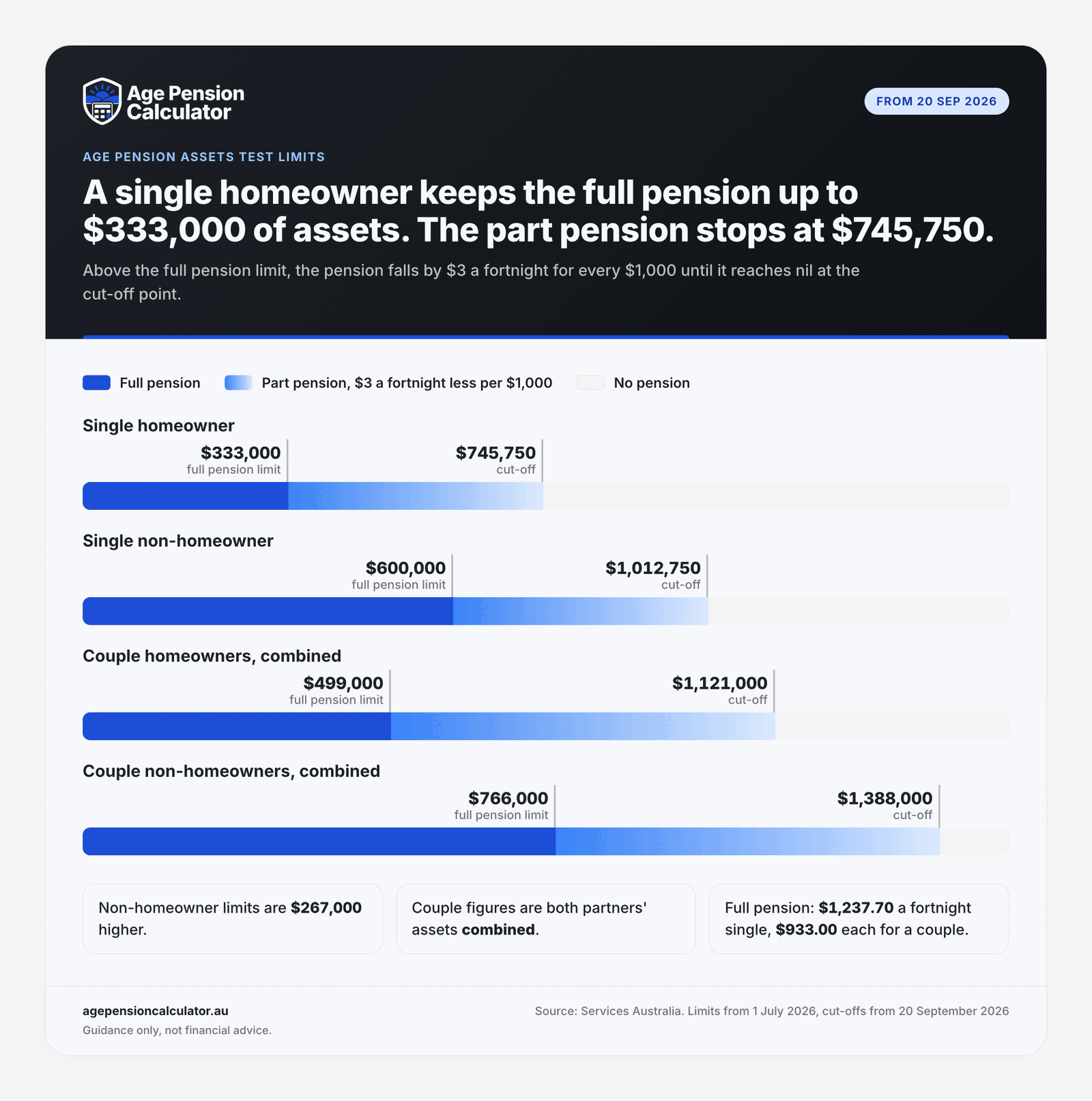
Figures in this graphic
| Situation | Full pension limit | Cut-off point |
|---|---|---|
| Single homeowner | $333,000 | $745,750 |
| Single non-homeowner | $600,000 | $1,012,750 |
| Couple homeowners, combined | $499,000 | $1,121,000 |
| Couple non-homeowners, combined | $766,000 | $1,388,000 |
| Your situation | Homeowner | Non-homeowner |
|---|---|---|
| Single | $745,750 | $1,012,750 |
| Couple, combined | $1,121,000 | $1,388,000 |
| Couple separated by illness, combined | $1,324,500 | $1,591,500 |
| Couple, one partner eligible, combined | $1,121,000 | $1,388,000 |
The cut-off points are higher if you get Rent Assistance with your pension. They move each time the maximum rates change, next on 20 March 2027.
Just below a cut-off point, the assets test can leave a rate smaller than the minimum rate. A rate above nil but below the minimum is raised to it: $61.60 a fortnight for a single person and $46.40 each for a couple. The minimum is the minimum Pension Supplement plus the Energy Supplement (Social Security (Administration) Act 1999 s43(5AA)).
How couples are assessed
Under section 1064 of the Social Security Act 1991, members of a couple are treated as pooling their income and assets and sharing them on a 50/50 basis. Each partner's assets are taken to be half of the couple's combined assets, and each partner's pension is reduced on that half.
A homeowner couple, both of Age Pension age, has $600,000 in savings and super. They are $101,000 over the $499,000 combined limit. Each partner's share of the excess is $50,500, or 202 whole steps of $250, so each pension drops by $151.50. The assets test leaves $781.50 each, $1,563.00 a fortnight combined.
The $250 rounding applies to each partner's half separately. So a couple's combined pension falls by $1.50 for every $500 of combined excess: $1,000 over the limit costs $3.00 a fortnight combined, while $999 over costs $1.50.
If your partner is under Age Pension age, the couple limits still apply to your combined assets and only one pension is paid. Your partner's super is not counted until they reach Age Pension age, unless their fund is paying them a pension. From that age it counts, even if they are not getting a payment.
Assets test or income test
Services Australia works out a rate under the assets test and another under the income test, and pays the lower of the two. If the two rates are equal, the income test applies. Savings and shares are counted in both tests: at their value in the assets test, and through deeming in the income test. Super is counted the same way once its owner reaches Age Pension age. Before then, super that is not paying a pension is not counted at all.
For the couple above, the income test would allow $1,673.84 a fortnight, so the assets test is the one that decides their pension.
Where the assets test takes over
If all your assets are savings, shares or super and you have no other income, the income test sets your rate at first. As your assets grow, the assets test gives the lower rate from about these amounts:
| Your situation | Assets test decides from about |
|---|---|
| Single homeowner | $377,750 |
| Homeowner couple, combined | $551,500 |
| Single non-homeowner | $729,250 |
| Non-homeowner couple, combined | $903,000 |
If part of what you own is not deemed, such as a car or household contents, the assets test takes over at a lower total. The Age Pension calculator runs both tests together on your own mix of assets and income.
Giving assets away
Giving money or assets away does not always take them out of the assets test. The gifting free areas are the same for a single person and a couple: $10,000 in one financial year, and $30,000 over 5 financial years with no more than $10,000 in any one year. Anything over those amounts is still counted in your assets test, and deemed in your income test, for 5 years from the date of the gift. Selling an asset for less than it is worth is treated the same way. See the Age Pension gifting rules for worked examples and a gift checker.
If your assets stop the pension: hardship provisions and the Home Equity Access Scheme
If the assets test stops or reduces your pension and you are in severe financial hardship, you can apply under the asset hardship provisions. Services Australia then uses a different method to work out whether you can be paid and at what rate. For a pension, all of these must apply:
- your readily available funds, such as bank accounts, shares and managed investments, are under $32,180.20 for a single person or $48,516.00 for a couple combined
- your other income is less than the rate of pension you would get
- there is nothing else you can reasonably do to improve your situation
- you own an asset you cannot sell, or would not reasonably be expected to sell
- you cannot borrow against that asset, or would not reasonably be expected to
- your pension would otherwise be payable under the income test
- the gifting rules do not apply or can be disregarded, and you cannot get any other Australian Government help
The readily available funds limits are indexed in March and September. To apply, you phone Services Australia. Services Australia also lists the Home Equity Access Scheme as another source of help.
Telling Centrelink when values change
You must tell Services Australia about changes to your income or assets within 14 days. For assets, that means when a value goes up by:
- $2,000 or more for financial assets, such as savings and shares
- $1,000 or more for other assets
Listed shares and market-linked managed investments are revalued automatically on 20 March and 20 September each year, and residential real estate values are adjusted each year. If the assets test is reducing your pension, tell Services Australia when the value of your assets falls, so you are paid the right rate. Services Australia also checks land title records against the real estate you declare.
When the limits change
The full pension limits are indexed to the Consumer Price Index on 1 July each year, next on 1 July 2027. The Department of Social Services reviews the limits and cut-off points in March, July and September. The maximum pension rates, which set the cut-off points, change on 20 March and 20 September, next on 20 March 2027.
- Services Australia: Assets test for Age Pension (page updated 20 September 2026), Asset types, Real estate assets, Superannuation, Funeral bonds and prepaid funerals, How much you can gift, Asset hardship provisions
- DSS Social Security Guide: 4.2.3 Pensions and benefits assets tests, 4.6.2.10 General provisions for exempt assets, 4.6.5.10 Assessing personal effects, household contents, vehicles and cash, 4.6.6.10 General provisions for valuation of assets
- Legislation: Social Security Act 1991 (Cth) s1064, Module G (Federal Register of Legislation, C2004A04121)
- Social Security (Administration) Act 1999 s43(5AA)
Read 24 November 2026.
Use the Age Pension assets test calculator for the assets test on its own, or the Age Pension calculator to see both tests together.