

The Age Pension goes up twice a year, on 20 March and 20 September. The last increase, on 20 September 2026, added $36.80 a fortnight for a single person and $55.60 for a couple combined. The next increase is due on 20 March 2027. Its amount has not been published yet.
Key takeaways
- Increases happen automatically on 20 March and 20 September. You do not need to apply.
- 20 September 2026: single up $36.80 to $1,237.70, couple combined up $55.60 to $1,866.00.
- Next: 20 March 2027. The amount is published shortly before the date.
- The basic rate follows prices and a wage benchmark. It cannot go down at indexation.
- Asset limits, income free areas and deeming thresholds move on 1 July instead.
When the Age Pension goes up: 20 March and 20 September
The Department of Social Services adjusts the Age Pension rates every 20 March and 20 September. Automatic increases on these dates have applied since 1990. You do not need to do anything: Services Australia pays the new rate from the indexation date. The current rates, single and couple, are in Age Pension rates from 20 September 2026.
The 20 September 2026 increase: $36.80 single, $55.60 couple combined
| Per fortnight | From 20 March 2026 | From 20 September 2026 | Change |
|---|---|---|---|
| Single, basic rate | $1,100.30 | $1,135.40 | +$35.10 |
| Single, Pension Supplement | $86.50 | $88.20 | +$1.70 |
| Single, Energy Supplement | $14.10 | $14.10 | No change |
| Single, total | $1,200.90 | $1,237.70 | +$36.80 |
| Couple, each, total | $905.20 | $933.00 | +$27.80 |
| Couple, combined, total | $1,810.40 | $1,866.00 | +$55.60 |
| Rent Assistance, single maximum | $219.40 | $223.80 | +$4.40 |
The earlier amounts are from the Department of Veterans' Affairs service pension table, which uses the same rates as the Age Pension. The changes are worked out from the two columns. The Minister for Social Services gave the same increases, $36.80 and $55.60, when announcing them.
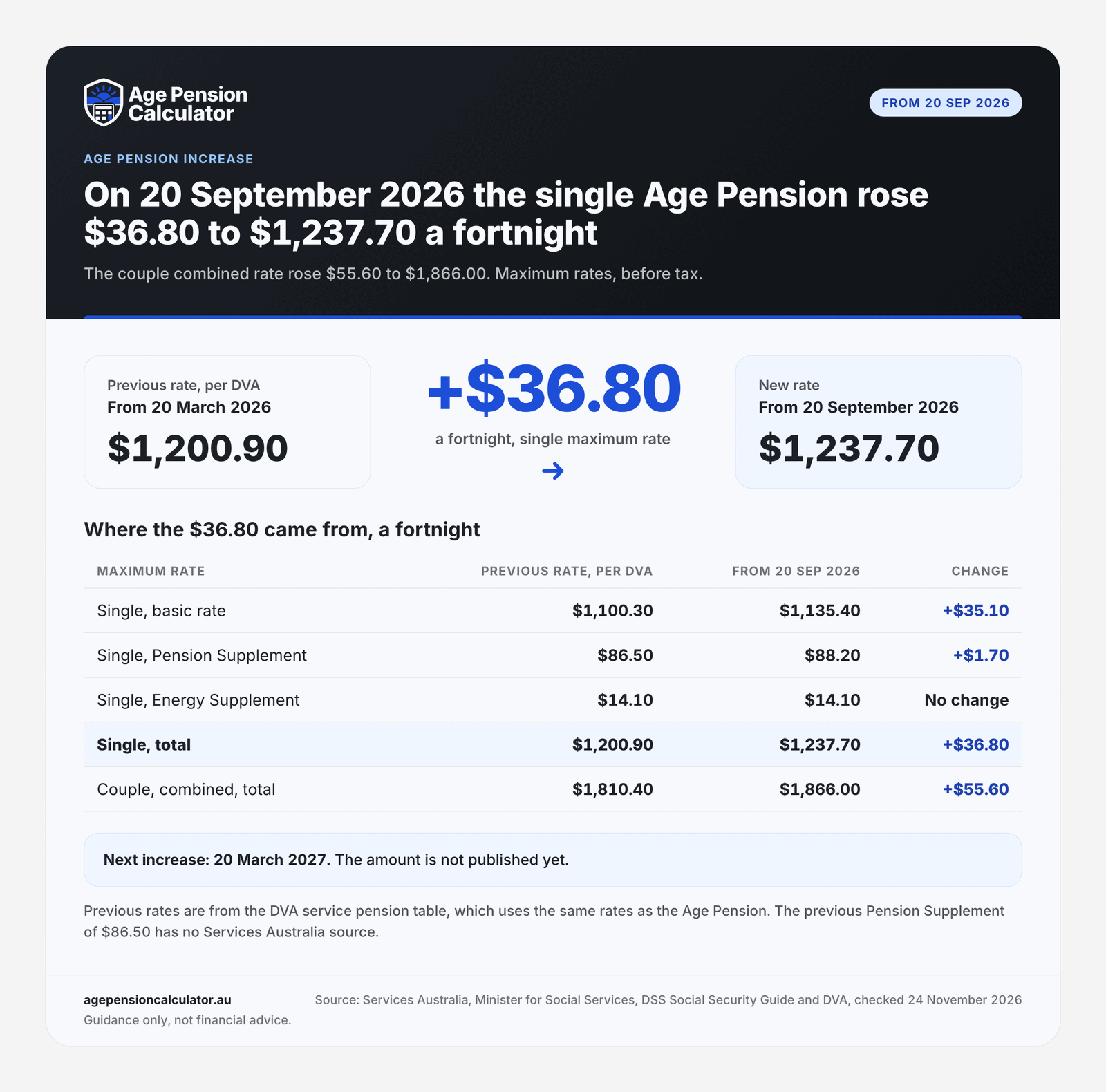
Figures in this graphic
| Maximum rate | Previous rate, per DVA | From 20 Sep 2026 | Change |
|---|---|---|---|
| Single, basic rate | $1,100.30 | $1,135.40 | +$35.10 |
| Single, Pension Supplement | $86.50 | $88.20 | +$1.70 |
| Single, Energy Supplement | $14.10 | $14.10 | No change |
| Single, total | $1,200.90 | $1,237.70 | +$36.80 |
| Couple, combined, total | $1,810.40 | $1,866.00 | +$55.60 |
The next increase: 20 March 2027
The current rates apply from 20 September 2026 to 19 March 2027, so the next increase is on 20 March 2027. That date is all that is published so far. Services Australia keeps new rates restricted until the Minister announces them or the Department of Social Services publishes them, which happens shortly before the date. This site does not estimate the amount.
On 20 March the Age Pension, the Pension Supplement and Rent Assistance are indexed. The income and asset thresholds are not: they move on 1 July.
How the increase is worked out: CPI, PBLCI and the wage benchmark
- Prices. The maximum basic rate is indexed on 20 March to the December quarter and on 20 September to the June quarter. The yearly rate is rounded to a multiple of $2.60.
- Living costs. If the All Groups Pensioner and Beneficiary Living Cost Index (PBLCI), the weighted average of the 8 capital cities, gives a higher amount than the Consumer Price Index, the PBLCI amount is used.
- Wage benchmark. The combined couple benchmark is 41.76% of annualised male total average weekly earnings (MTAWE), which is 52 times the weekly figure. If half the benchmark is more than the indexed partnered rate, the partnered rate is raised to it.
- Single rate. The single basic rate is set at 66.33% of the couple combined basic rate.
- No falls. If prices fall, the indexation factor is raised to 1, so the rate stays the same.
A check with the current figures: the DSS guide gives a yearly partnered basic rate of $22,253.40 from 20 September 2026. Twice that times 66.33% is $29,521.36. Rounded to the nearest multiple of $2.60, that is $29,520.40, the single yearly rate of $29,520.40.
What else changes on 20 March and 20 September
- Pension Supplement: indexed to the Consumer Price Index on the same dates. It is not benchmarked against MTAWE. See What is the Pension Supplement?
- Rent Assistance: the rent thresholds and maximum rates are indexed to the Consumer Price Index. The maximum rates also had one-off rises of 15% on 20 September 2023 and 10% on 20 September 2024, on top of indexation.
- Cut-off points: when the rates go up, the income and assets test cut-off points go up too, so you can have more income or assets before a part pension stops.
What changes on 1 July instead
The income free areas, the assets test full pension limits and the deeming thresholds are indexed on 1 July each year. They do not change in March or September. The rules for each are in Age Pension income test, Age Pension assets test limits and rules and deeming rates.
What is not indexed: the Energy Supplement and deeming rates
- The Energy Supplement is not indexed. It stayed at $14.10 a fortnight single on 20 September 2026.
- The deeming rates are set by the Minister, based on advice about what the markets are doing. They are not indexed.
When the new rate reaches your bank account
The pension is paid fortnightly in arrears, so the indexation date usually falls inside a payment period. Part of that fortnight is paid at the old rate and part at the new rate, each worked out as the yearly rate divided by 364 for each day.
For a single person on the full rate with 7 days either side of 20 September 2026: 7 days at the old rate of $1,200.90 a fortnight is $600.45, and 7 days at the new rate of $1,237.70 is $618.85. That fortnight pays $1,219.30. The first full fortnight at the new rate pays $1,237.70. Services Australia's own example uses the same method with older rates.
Recent Age Pension increases: basic rate
The maximum basic rate at each indexation date from the DSS guide, a fortnight. It leaves out the Pension Supplement and the Energy Supplement. Fortnightly amounts are the yearly rates divided by 26.
| From | Single | Change | Couple, each | Change |
|---|---|---|---|---|
| 20 September 2026 | $1,135.40 | +$35.10 | $855.90 | +$26.50 |
| 20 March 2026 | $1,100.30 | +$20.60 | $829.40 | +$15.50 |
| 20 September 2025 | $1,079.70 | +$28.40 | $813.90 | +$21.40 |
| 20 March 2025 | $1,051.30 | +$4.20 | $792.50 | +$3.20 |
| 20 September 2024 | $1,047.10 | +$26.50 | $789.30 | +$20.00 |
| 20 March 2024 | $1,020.60 | $769.30 |
Age Pension increase questions
When is the next Age Pension increase?
How much did the Age Pension go up in September 2026?
How is the Age Pension increase calculated?
Can the Age Pension go down at indexation?
Do I need to apply for the increase?
When do asset limits and income free areas go up?
Services Australia: How much Age Pension you can get, Deeming. Operational Blueprint: Indexation, Indexation dates. Minister for Social Services: media release on the 20 September 2026 rates.
DSS Social Security Guide: 5.2.2.10 Maximum basic rates of pension, 5.1.9.10 Pension supplement rates, 5.1.7.10 Rent Assistance, 3.15.2.20 Energy supplement, 4.2.1.10 Income free areas. Legislation: Social Security Act 1991. Earlier rates: DVA service pension table.